Showing posts with label san francisco. Show all posts

29 September 2009

Portrait of an SF Street Musician

Rich Cianfrone is a 52-year-old New Jersey native who paints houses to get by. But on the weekends – and when business is slow – he performs on the sidewalks of the famous Haight Ashbury neighborhood to keep the San Francisco Sound alive.

I met Rich outside of the Richmond District home where he rents a room. He led me up a few flights of creaky stairs to his bedroom, the small space he shares with his pet cockatiel. “My bird will be excited to meet you,” the 52-year-old New Jersey native said in his thick accent. “We don’t get too many ladies coming around here.”

He opened the door to his bedroom, the small space he and his cockatiel, a male named Claire, call home. The scents of marijuana smoke and the small animal wafts from his room into the musty hallway.

It is a sparsely decorated bedroom. The walls are white, with a few posters of bands and concerts serving as the only decorations. A twin bed covered with a brown fleece blanket hugs one wall. On the opposite wall sits a large stereo with two giant speakers. Above it are a few shelves littered with CDs of his favorite bands and a framed picture of the late Jerry Garcia. An old television squats in the corner by the window. The last wall is occupied by a white dresser, which contains all of his clothing and possessions.

Atop the dresser, his main companion Claire was climbing around outside his cage, jumping from the edges of cups and bowls. Rich found Claire in his backyard over three years ago and regards him as a son now. The bird’s sunshine yellow face and rosy pink cheeks were one of the only elements brightening up the room. Rich has three grown children, but he is currently estranged from them. No photos or remnants even hint at their existence. His marriage to their mother ended seven years ago, at which point he moved out west.

Rich is a broad shouldered man, thick with muscle from his labor-intensive day job. That day he wore a white wife-beater, a pair of light denim jeans and faded gray tennis shoes. His long hair was pulled back in a curly grey ponytail, except on the top where his bald crown shone through. He is missing a few of his front teeth, which occasionally adds an endearing lisp to his speech.

He pulled out a thirty-year-old guitar and began to play along to some CDs. “I’m a real fan of the San Francisco sound,” he said. “You know, Quiksilver, the Dead, Jefferson Airplane, Hot Tuna, The Stones, Moby Grape.” Rich was growing up in New Jersey when the San Francisco music scene was at its peak in the 1960s and 70s. But he said a Grateful Dead concert he saw with friends back home converted him from a heavy metal devotee. Now his heart lies with the artists that infiltrated San Francisco decades ago. He strummed along to the tunes he knows so well, Claire squawking along to the music.

After warming up sufficiently, Rich decided it was time to head out to the streets where he plays. He pulled a white cap emblazoned with the logo for Kelly Moore paint over his head, and lugged his guitar out the door and on two busses to get across town to where the San Francisco Sound originated: the Haight Ashbury neighborhood.

Walking up and down Haight Street, he chose what he considered a perfect spot to perform. There are many considerations that go into choosing that perfect stretch of sidewalk. For one, the spot must not be in front of an open business, or the business owner will usually shoo the busker away. Also, if it is a particularly warm day, it should be in the shade. Lastly, it must be a suitable distance from competing performers. That day, Rich was performing in front of a closed up storefront splattered with graffiti. On the corner, a young woman with long flowing hair played the violin, and midway down the block, some male guitarists were covering Johnny Cash songs.

He opened his guitar case, knelt on the sidewalk, and began tuning as though he were in his own home. He dropped a few dollar bills and change into the open guitar case to prompt others to leave tips. He stood up and began to play. His accent was just slightly detectable in song, and he strummed the guitar gruffly. But what he lacked in talent, he made up for in spirit. His own personal hardships came through in his covers of the famous tunes. And his eagerness to entertain came through in the smile he flashed at each person who passed.

The weekends draw hoards of tourists and locals to this historic neighborhood, and this sunny Saturday drew even more than usual. The crowd was mostly young and mostly fashionably dressed. Most seemed to gaze right past Rich as he began playing the old songs that once defined this neighborhood. Now trendy boutiques and souvenir shops selling reminders from the past give this neighborhood its identity.

Rich played for about an hour, making only two dollars in that time. He grew hungry and decided to get a slice of cheese pizza and a small Coke. On the walk to the pizza parlor, he stopped to give a fellow street musician advice on how to string his guitar. The two discovered they were both from the East Coast and chatted joyfully. After lunch, Rich stepped out on a side street to take a few puffs from a small joint, which he’d been storing in his zippered coat pocket. He has a regular cigarette lit simultaneously to thwart suspicion of passersby.

As the afternoon dragged on, “Why do you perform?” became the glaringly obvious question. It clearly wasn’t for the money, which wasn’t even enough to cover the cost of lunch. It didn’t even seem to be for the attention; most people seemed to glaze their eyes right past him.

Rich said, “You know, it’s like they say, why have music if no one hears it?” He continued, “For me, it’s not about the money. It’s worth more to me if someone says ‘thanks for keeping it alive’ than if they hand me a dollar. Besides, you can’t make a living doing this.”

For Rich, times have become hard. House painting jobs are harder to come by these days, he said. He blames the influx of inexpensive migrant laborers for this difficulty. Perhaps this hobby brings fulfillment to a man who is dissatisfied with work. Perhaps it fills a void that has been empty since he lost touch with his ex-wife and three children. Perhaps it brings a lost sense of community. Perhaps it makes a man whose best friend is a bird feel appreciated. Or perhaps it is, as he says, simply about keeping the San Francisco sound alive.

Rich settled back into his spot after his break. His guitar is worn out, weathered from many-a-day spent out in the elements. He flung the purple strap over his shoulder, which is so old it requires a shoelace to keep it attached to the guitar. He started to play a different kind of tune, the old Motown hit “My Girl.”

An older man walked by. His eye sparkled and he whistled along to the familiar tune. Smiling, he dropped a dollar into Rich’s open guitar case and simply said, “Thanks.”

25 April 2009

Dim Sum for Dim Dummies

I was most hesitant about the trip to Chinatown in the semester leading up to it in my Eating San Francisco class. Whereas all the other neighborhoods we visited were home to cuisines familiar to me, such as Mexican or Italian, the plan for Chinatown was to eat a brunch of Dim Sum, which I had never done before.

I'd been to Chinatown in the past, but mainly to the main tourist drag: through the Dragon Gate leading from Union Square area to Grant Avenue, which is lined with an endless array of souvenir shops. But I knew there was much more to this historic neighborhood than just cheap Buddha statues and paper fans and dragon-motived knick knacks.

A bit of online reading gave me a good sense of the history of this neighborhood. Chinatown actually started out as a ghetto for Chinese immigrants in San Francisco, when they began arriving in the 1850s in waves to work as cheap labor on the railroads or Gold Rush miners.

Americans soon began feeling hostile toward their new neighbors because they worked so hard for so little money and were coming in such an influx that jobs were at a shortage. Government began to enforce this discrimination with legislation such as the Chinese Exclusion Act of 1882.

Despite these restrictions, Chinatown continued to flourish as a hub for Chinese immigrants, with schools, churches and shops owned by Chinese people.


Nowadays Chinatown is somewhat touristy and Disneyland-ified (given an exaggerated theme to draw more visitors), but it is not all a facade. Between the crowded sidewalks full of Chinese shoppers stocking up on fresh groceries and store owners tending to their small shops and markets, peppered with lively conversations in Cantonese, I actually feel like I've stepped into another country when I walk around there.

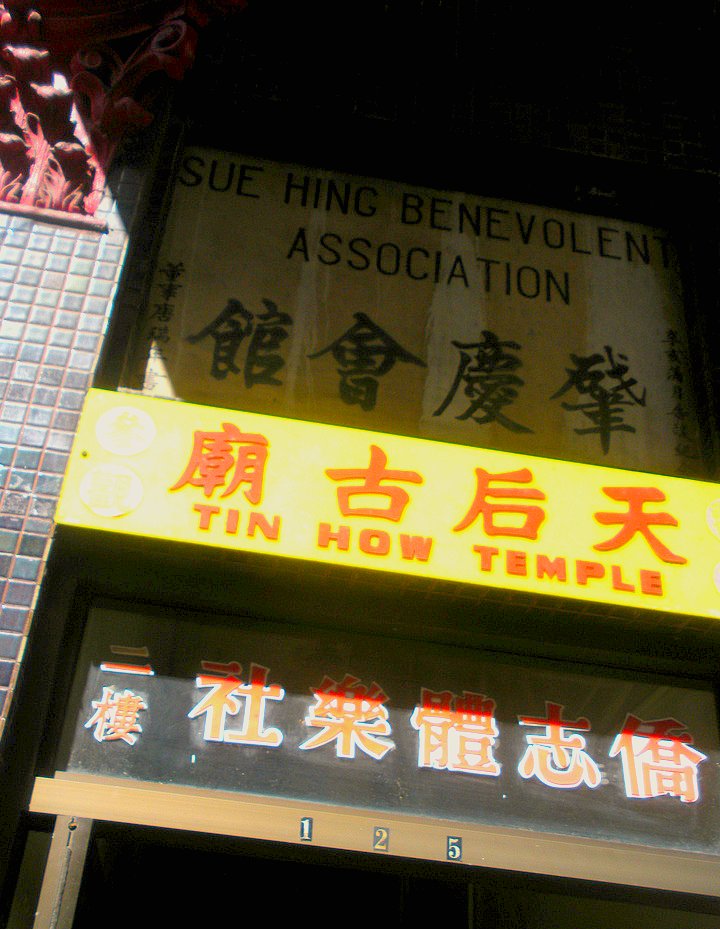
When I went with my ESF class, we stopped at the Tin How Temple, a dim sum restaurant called New Asia Chinese Restaurant, and finally to the Golden Gate Fortune Cookies factory.


The Tin How Temple is the first Chinese Temple in the United States. Walking inside, up about four flights of narrow stairs and finally into a tiny room, it was a wonder that anyone could ever find this place. The room inside was filled with the fragrant smoke of incense and stung my eyes. A group of elderly Chinese women seemed to be running everything here. One very kind woman showed our class many aspects of the temple unfamiliar to us and taught us how to ask for a fortune. Turns out you don't just crack open a cookie. I enjoyed learning about the rituals observed in the temple, which were new to me.

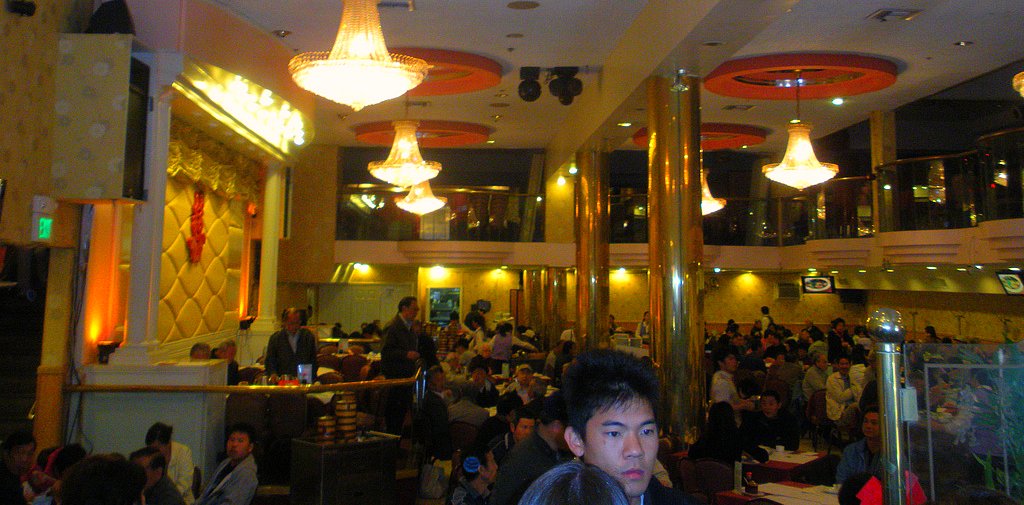
Next was brunch. I was starving by this point! We crawled out from the dreamlike haze of the temple into the bright daylight, ready for dim sum. We were walking through streets I had never been on before and I began to understand that Chinatown is for more than the tourist trap I previously thought it was. Many Chinese-Americans perused the streets, doing their everyday grocery shopping or meeting for a meal. Most of them seemed to be meeting at New Asia like we were -- it was absolutely packed inside. It's always a good sign to see locals dining at the establishment you choose, which seemed to be the case.


The restaurant was a huge open room full of many round tables, each surrounded by many chairs, all of which were filled with hungry patrons. Weaving between the tables were waiters wheeling carts of small dishes meant to be shared by the groups.

Finally seated, food was instantly presented to us by some rather pushy servers. They would usually hold a dish out to us, expecting an instant reply of "yes" or "no." They had little patience for questions or hesitation. We seemed to be choosing randomly. I had no knowledge of popular dim sum dishes prior to this, but it seems we tried most of the ones other tables had, and a few others.

Over all I felt pretty overwhelmed by the dim sum experience. It was a bit stressful trying to be mindful of servers shoving food at you constantly and trying to decide if you wanted it or not. Being a somewhat picky eater, a lot of the dishes looked off-putting to me. I tried most and was often pleasantly surprised that I liked them. However, others I would rather not have tried. What I did enjoy most about the dim sum meal is that it was very interactive and made us focus on our food, discussing what we liked and what we should order next as a group.


We walked off our meal as we strolled over to the Golden Gate Fortune Cookie factory. Like the temple, it was tiny, located in an alleyway with a barely noticeable storefront. Inside we got to see fortune cookies being made, from flat discs made by a small machine and then folded in half with a fortune inside by hand. This process was mesmerizing to watch.

I was happy to have spent this day with ESF in Chinatown. It gave me a fresh perspective on the neighborhood that I thought was a mere tourist trap. It also gave me my first taste of dim sum, which I think, with more knowledge and experience under my belt, I will someday enjoy very much.

By the way, in my reading I found this fascinating account from a former chief of police Jesse B. Cook (1860-1938) where he describes Chinatown's sordid beginnings, which included gambling, prostitution, opium dens and gang wars. A fun and interesting read from a white man trying to keep the "Chinamen" under control, with some great old photos.

11 March 2009

The San Francisco Burrito

In food movies such as Big Night and Like Water for Chocolate, the preparation and consumption of food can symbolize everything from personal emotions to societal concerns such as class, ethnicity and gender issues. In real life, the foods consumed by a certain demographic or region can be meaningful as well. In the Mission District of San Francisco, the burrito is symbolic of the struggle of Latin American immigrants to maintain their traditional culture while fitting in to a new society and the sacrifice it takes to immigrate to a new country and work hard for a better life. Huh? Maybe a little background will help.

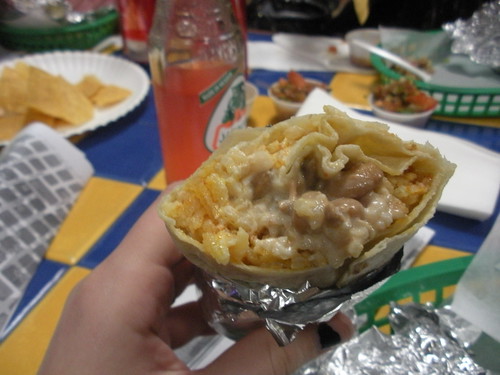
The San Francisco burrito is not traditional Mexican fare contrary to popular belief. Though small tortillas wrapped around meat and beans were served in Mexico as the first burrito, only in San Francisco did the burrito evolve into what most Americans recognize today. The defining features of a San Francisco burrito are an over-sized flour tortilla, stuffed with rice, beans, cheese, meat, salsa, and sometimes avocado, salsa, sour cream, onions, tomato, cilantro, etc. This basic concept has taken off in popularity and it is now standard to find a similar entree everywhere from Chipotle to Chevys.

The San Francisco burrito got its start when farmers in the Central Valley of California needed a cheap filling meal to give their immigrant workers on their lunch break. Most of these workers came from Mexico and Central America. The giant tortillas stuffed with hot, filling ingredients was just the right fuel to keep the workers going all day.

The rice and beans, are at the foundation of this. Rice and beans have long served as sustenance in the Latin American and Carribean cultures. The combination of the two are not only tasty but more importantly are incredibly dense in nutrtitional value, with fiber, vitamins, minerals, and when combined, form a perfect protein. This makes it the perfect basis for a filling and nutritious meal. When combined with meat, cheese and flavorful salsa, it is the perfect meal to fill you up and provide a tremendous amount of energy.

The burrito came to San Francisco as waves of Latin American immigrants came into the Mission District, replacing the Polish and Irish cultures that were dominant at the time with their own. The Latin American culture is still dominant today. With their taquerias and bakeries and churches and colorful murals splashed throughout the neighborhood, the Mission now has a strong Latin American influence. But stepping into the neighborhood isn't exactly like stepping off an airplane onto Mexican soil. It represents a fusion of the different cultures of Latin America all coming together in a diverse urban city. Likewise, the burrito is not a traditional dish from any one Latin American country, but it uses popular staple ingredients from the Americas, wraps them up in an all-encompassing tortilla, and serves them up to anyone and everyone.

To experience this cultural fusion, my Eating San Francisco class met in the Mission District last Wednesday at Balmy Alley, one of the premiere mural spots in the neighborhood. Murals and street art have been used in the Mission for decades to express political and social concerns of the Latin@ culture.

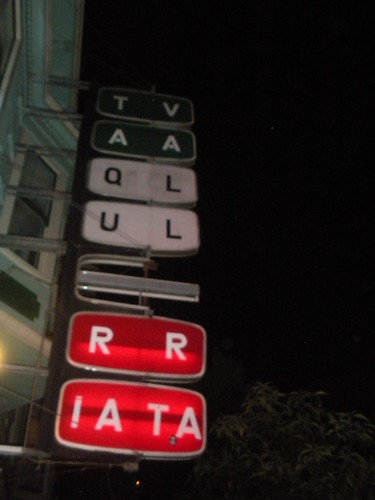
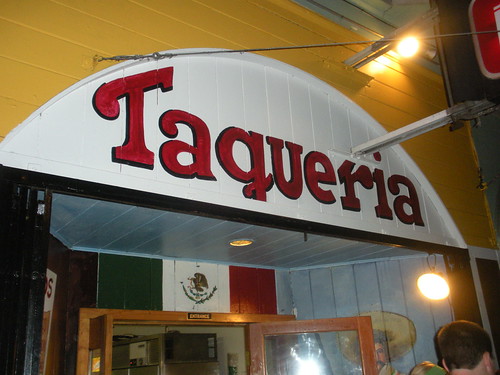
From there we headed to a taqueria just around the corner. I've probably been to at least 10 taquerias in the Mission, and I swear I've barely scratched the surface. This one, called Taqueria Vallarta, was new to me and I was excited!


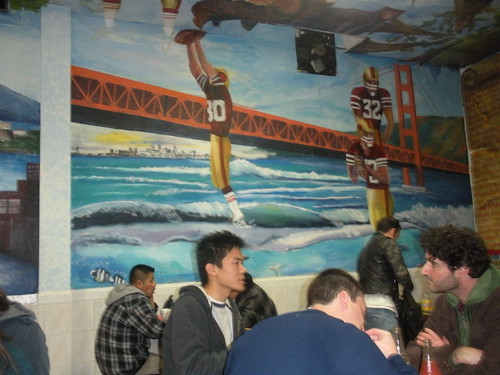
The inside was kind of funky. There were murals all over the wall, and although done in the realistic style of Diego Rivera and other Latin American muralists, they incorporated modern imagery of local landmarks and athletes. Not exactly the kind of political message murals usually incorporate, but fun and colorful nonetheless.


The food was delicious, and they were extremely accommodating of our large group! Most of the group went with some form of burrito or chimichanga, but many also enjoyed the taco bar. I got my usual vegetarian burrito. I get this at almost every taqueria I step foot in, which may seem boring, but also gives me a standard unit of measurement for how much I enjoy each place. This one was excellent, with perfect ratios of beans, cheese and rice, all well seasoned.

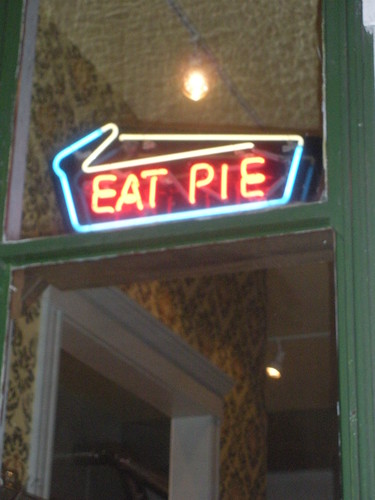
After a wonderfully filling meal, the 18 of us migrated from 24th & Balmy to Mission Pie at 25th & Mission. Mission Pie is a place I had heard a lot about but never gotten around to visiting. It is a fabulous concept incorporating locally grown produce at Pie Ranch with students at Mission High who all work together to grow the food and cook the pies at Mission Pie.


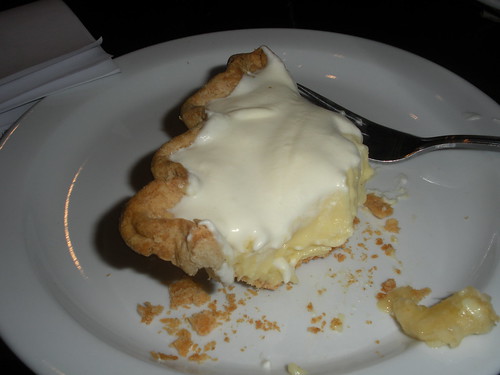
Mission Pie is a cozy spot that I look forward to coming back to. Though I don't reccomend going with a group of 18 people, they managed to accomodate us and one of the Mission High students even came and told us about the ranch and the shop. Then we enjoyed our delicious pie... and mmm it was good.


All in all another successful ESF outing, full of good people, good food, and good learning.

Check out my Yelp reviews for more specific descriptions of the food and overall experience at Taqueria Vallarta and Mission Pie.

30 September 2008

new gig

You're looking at the newest intern for High Speed Productions, Inc.

HSP produces three magazines: Thrasher, Juxtapoz, and Slap. Today was my first day, and I spent the entire time transcribing an artist interview that will appear in Slap. I may be developing carpal tunnel syndrom. But I couldn't be happier.

:)

08 May 2008

We've been busy

Final class of digital journalism was today. We worked on our map, ate pizza, reflected on our blogs, cried a little on the inside that the class was over... haha, only half-serious about that last part. Okay, mostly I am serious.

Well, anyway, here is all we have to show for our semester of hard work: We hit the pavement, exploring the school, the park, and the city til our feet blistered; we snapped pictures til our eyes hurt; we blogged our fingers to the bone; and finally, we sat down and mapped it all.

Click on a pin. See what happens. Explore USF, Golden Gate Park, and the city of San Francisco all from your computer screen. Enjoy!

CommunityWalk Map - USF, the Park, and San Francisco

01 May 2008

A night at the Rickshaw Stop

Between living on campus, going to classes, doing homework, working on the Foghorn and working at an on-campus job, I spend more time at "school" than in the "city" than my blog title would suggest. Still, I try to get off campus as much as possible. Over the weekend is always the best time.

Last weekend, three friends and I saw a show at the Rickshaw Stop on Fell and Van Ness. From campus, all we had to do was walk to Hayes and take the 21 to Van Ness.

I had never been to the Rickshaw Stop before, but I had heard it was one of the few cool 18 and over spots to hang out, and they have something going on almost every night of the week.

There was a minimal line at the door when we got there. The people there were definitely very "hip." I observed some cutting edge fashions that I had never seen before -- from a guy in (very) short shorts to a girl wearing a bikini top with a baggy, very low cut tee-shirt over it. My friends and I are stylish, but not to this extent. A lot of them looked a little silly to me.

We walked in, and the place was pretty dark. There is a bar near the door, a big dance floor, and a stage in front. A DJ was spinning tunes while the crowd warmed up and danced. Everyone was taking pictures and dancing. Upstairs, a more laid back vibe prevailed, with couches and places to talk.

The band that was performing tonight was called the Plastiscines. They were very rad.. check out the audio slideshow I put together from my pictures from the show.


I had a good night at the Rickshaw Stop, but the crowd was probably not my favorite... Everyone was a little too hip and image-concerned for my taste. I did love the music, though, so I may go back if a good band is playing; til then, I'll be on the look out for someplace better.

23 April 2008

Heart of the City

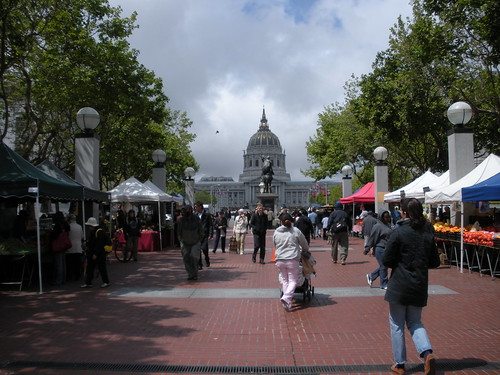
The outside market that takes place in the U.N. Plaza every Wednesday and Sunday is called the Heart of the City Farmers Market. I couldn't think of a better name for it if I tried, for it truly is a place where the heart and soul of San Francisco shines.


The farmers market seems to be a place for everyone in the city to come together. Whether we're rich or poor, white, black, Latino, Asian, old, young, all or none of the above, we all have to eat.

What we choose to eat has become a very complicated issue in this day and age.


Locally grown? Organic? Fair trade? Genetically engineered? Pesticide free? Cage free? Steroid free? Hormone free?

It's enough to make one's head spin.

To further complicate things, the world has gone into a Global Food Crisis.

The price of staple foods such as corn, soybeans, rice, and bread have become so unmanageably high that thousands of people around the world are starving. Such a tragedy that is leading to much suffering and political unrest. Just awful.

* * *

Needless to say, I feel blessed to be able to enjoy whatever foods I want, whenever I want.

Not only is a plethora of food available to me at farmers markets, grocery stores, restaurants, vending machines, and the USF cafeteria, but also the affordability of said foods has never been an issue for me.

While this is without doubt a blessing, there seems to be something almost unnatural about not having to struggle for food.
I have never once had to worry about where my next meal was coming from.
It's just something to think about.

* * *

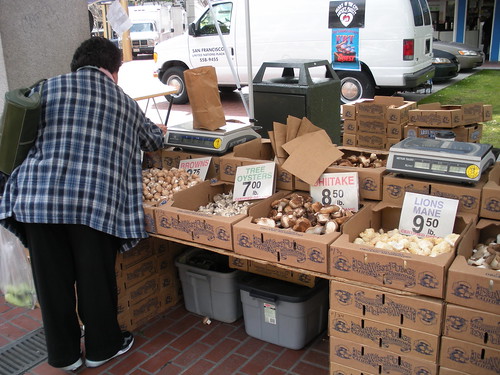
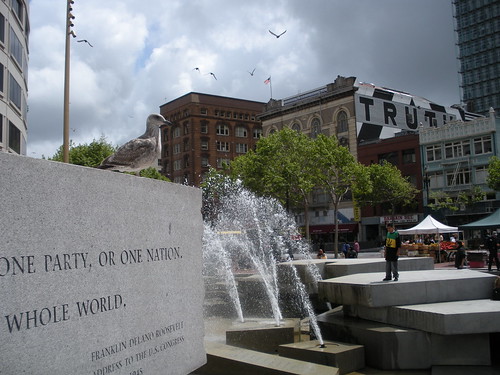
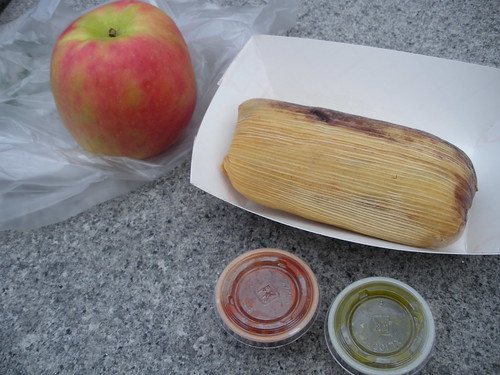
After spending a day perusing through the Heart of the City Farmers Market, soaking up the sun, examining all the fresh produce, watching people scrutinize long, slender carrots and bunches of leafy kale, I settled by the fountain to enjoy a hot black bean tamale and a plump pink lady apple.


Food is a surprisingly complicated issue, but one thing I know is that food should be enjoyed and appreciated.

22 April 2008

Thrift Town

This weekend, I spent a sunny (yet windy) day in the warmest part of town: the Mission district. I always enjoy spending time there due to the variety of fun shops, interesting people, taquerias, and cool street art. But one of my favorite things to do in the Mission is shop at the thrift stores.

Thrift Town on 17th and Mission has to be one of the best thrift stores not only in the Mission but in all of San Francisco.


Photo Courtesy of dsguestblog.blogspot.com

Thrift Town is very large and very well organized, making it very easy to navigate and find whatever you are looking for. While many thrift stores have crammed racks of clothing that is organized in no particular fashion, Thrift Town organizes its goods by category, size, color, etc.

It is not so organized that it lacks character, though. There is always a lot of variety and plenty of surprises. You can find golf clubs, old electronics, books, toys, clothes, shoes, lamps, dishes, housewares, and more. Really more. There's all kinds of random surprises to be found.

The prices are very reasonable, too. While some urban thrift stores mark up their wares due to their popular locations and the newfound chicness of vintage clothing, Thrift Town is indeed a place to wear thrift is still part of the equation.

During my visit, I acquired two books, a pair of shoes, a floral scarf, and a skirt for about $20.

After a visit to Thrift Town, I recommend checking out one of the amazing taquerias the Mission has to boast for a thrifty yet satisfying meal.

10 April 2008

Serene garden with a sordid past

A serene space, a taste of Japan, a moment of calmness and clarity -- it is hard to believe that the Japanese Tea Garden is located in one of the most densely populated cities in America.


The history of the Japanese Tea Garden, the first public Japanese garden in the United States nestled comfortably in Golden Gate Park, started out innocently enough. The garden was constructed for the 1894 Midwinter International Exposition, conceptualized by landscape designer Makoto Hagiwara. It was originally built as a "Japanese Village," meant to give Americans a taste of Japanese culture. In this time, the Japanese were a very small minority in this country, their culture largely unknown. The garden was an honor to their country.

The Japanese Village in 1894

After the fair passed, in was renovated as a garden, which was occupied and maintained by the Hagiwara family. They lived in a small house within the garden's property for many years.

Mr. Hagiwara and his daughter in their home, 1924

In 1942, all that changed.

America was in the midst of World War II, and Japanese Americans were under federal order to be evicted from their homes and sent to internment camps, often separated from their families. This ugly chapter in America's history did not fail to impact the Hagiwara family, despite their public service to the San Francisco community and an agreement with John McClaren that the family would tend to the garden for a century.

The family was sent to internment camps. Rubbing salt in the wound, the garden was renamed the Oriental Tea Garden, and Chinese women in Chinese costumes replaced the Japanese ones who served tea in the garden. The garden is said to have fallen into disrepair without the intricate care Mr. Hagiwara provided.

By 1952, the war had ended, and the garden was once again named the Japanese Tea Garden. The family home was destroyed during their years of absence, and the city of San Francisco refused to allow the family to return, despite McClaren's promise.

It is said that since the Hagiwara family left, the garden has never been the same, though it has improved in recent years, more rare plants being replanted each year. It is now a favorite spot for tourists in the park, the bridge a delight for children to climb, and the large, 3,000 pound Buddha statue an impressive, spiritual addition.

Erik Sumiharu Hagiwara-Nagata, Makoto Hagiwara's great-great-grandson, continues the family tradition of gardening, running his well respected plant nursery in Penngrove, California.

25 March 2008

New toy

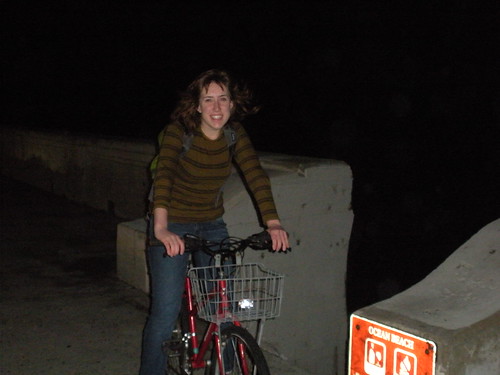
My new toy: A shiny red bicycle with a basket (I love the basket!).

I bought this bike via an ad on Craigslist the day before I left for my NYC trip. Since I've returned, I have been riding every day.

I've always enjoyed bicycling somewhat, but was intimidated by the idea of riding in this busy city. I brought my old bike to school my freshman year, but I never rode it much, and then it was stolen. Not having a bike pushed the idea of biking out of my mind for obvious reasons.

A few weeks ago, my good friend Chelsea bought a bike, also through Craigslist, which inspired me to follow suit. I am so glad I did! So far, I have stuck to somewhat quiet streets, but I've found that negotiating the road with car traffic is not difficult. Perhaps because bicycles are so prevalent in this city, and thanks to the activism of the San Francisco Bicycle Coalition, cars are understanding and sometimes even courteous to the needs of cyclists.

Last night, Chelsea and I rode from USF to Ocean Beach and back. Gliding down a city street against the wind with the expansive Pacific Ocean visible at the end of the long road feels so exhilarating. And reaching the beach is just such a sweet reward for the hard work of climbing those San Francisco hills.

I can't wait to check out new areas of the city with this new mode of transportation.

27 February 2008

The only thing better than travel...

The only thing better than traveling is doing so on someone else's dime.

I have not one but two all-expense paid trips coming up. To answer your question, yes I do pinch myself to make sure I'm not dreaming. Trust me, it's true.

The first trip is from San Francisco to New York City over spring break.


View Larger Map

I am going on this trip with three other editors from the Foghorn for a college journalism conference. During the days we'll get to learn all of the latest innovations in student journalism, and at night we'll peruse one of the few cities I would consider as cool as San Francisco.

The second free trip is to Israel over summer vacation.


View Larger Map

This trip is through the Birthright Israel program, which provides free trips to Israel for any young adult of Jewish descent to expose them to Israeli culture (and, I suspect, to try to convince them to move there). I have no idea what to expect -- the only place I've been outside of North America is Holland, where my brother-in-law is from -- and have a feeling that Israel will be quite a culture shock. I am really excited to be exposed to such a different way of life.

15 February 2008

Pillowpalooza

Sometimes people I know from home ask me what it's like living in San Francisco. I always end up smiling, thinking really hard, and coming up with a terribly inadequate answer. The truth is, it is the kind of thing that cannot be explained.

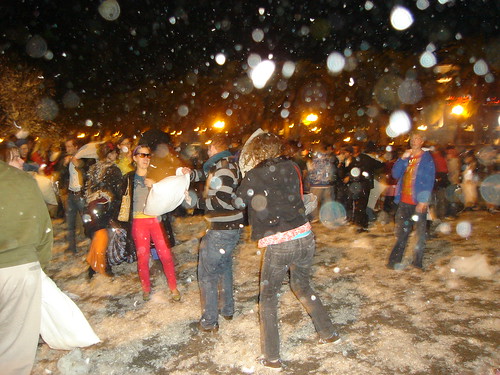
Last night was Valentines Day, and while I imagine the single citizens of most cities moped around their apartments in their p.j.s and ordered pizza, that kind of thing just wouldn't fly here.


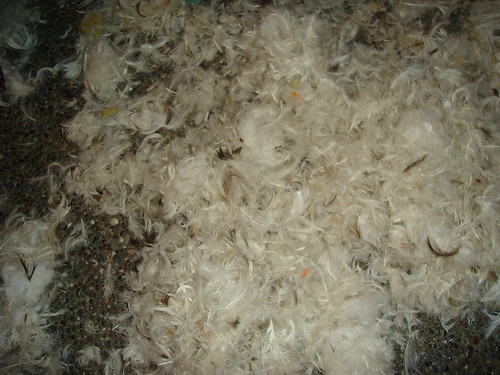
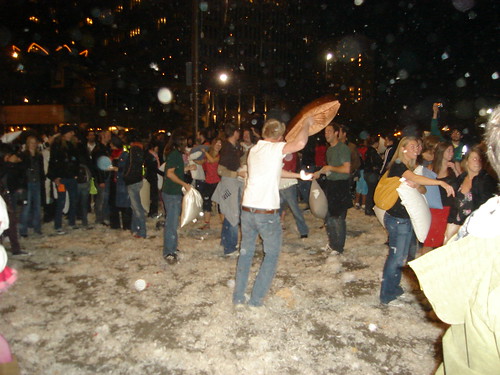
City-wide Valentines Day Pillow fight. That is just one of the reasons I love San Francisco.